The auctioneer is in Austin. The estate is in a barn outside Stowe, Vermont. Two thousand miles. Five hours of driving plus a flight. The auctioneer doesn’t want to make the trip and the consignor can’t wait three weeks for the next available date.
Five years ago this auction doesn’t happen. Today it does — and the auctioneer never leaves his counter. He pours a coffee, opens his laptop, puts on a headset, and runs a live auction with a hundred bidders watching from another time zone. The estate clears. The consignor gets paid. The auctioneer is home for dinner.
This article is the technical walkthrough of how that setup actually works — the architecture, the gear, the latency budget, and the four failure modes that will eat your auction if you don’t plan for them.
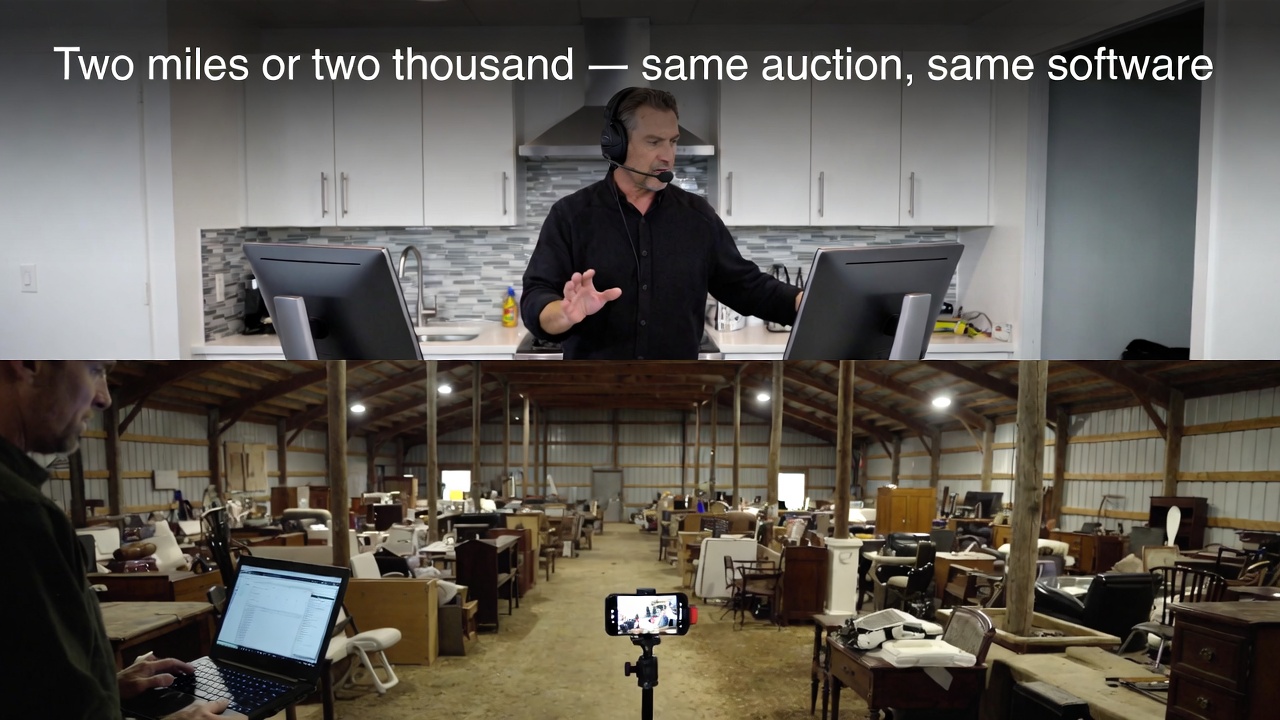
The two-end architecture
A remote-auctioneer auction has exactly two ends.
The auctioneer end is wherever your auctioneer is sitting. A house, a hotel room, a coffee shop with reliable wifi. Their gear: a laptop, a USB headset with a mic, ideally a second monitor.
The auction-floor end is wherever the inventory is — the barn, the estate house, the warehouse. Their gear: a person on the ground, a phone or tablet for catalog access, a video stream of the lots, and (if you have an in-person bidding crowd) a speaker so the auctioneer’s voice plays loud enough to hear over the goats.
Between the two ends: an internet connection, an auction platform with simulcast streaming, and an audio path that rides separately from the video so a hiccup in one doesn’t kill the other.
The four roles, redistributed
A traditional in-person auction has four roles in one room: auctioneer, ringman, block clerk, and runner. A remote-auctioneer auction puts those same four roles on a map.
- Auctioneer. Wherever they are. Calling the bid into a USB headset.
- Block clerk. On the auction-floor end. They’re still typing into the auction software, still hitting SELL, still watching for the “Internet Winning” indicator. They’re also the auctioneer’s eyes on the room — the auctioneer cannot read body language two thousand miles away, so the block clerk does it for them.
- Ringman. On the auction-floor end too, working any in-person bidders. If your auction is 100% online, you skip this role.
- Internet ringman. Possibly co-located with the auctioneer, possibly with the block clerk. Watching the online bidder feed, surfacing “Internet Winning” bumps to the auctioneer in real time. The block clerk often plays this role too — same instincts, different audience.
The block clerk is the linchpin. They’re the only person physically near the inventory who can confirm what the lot is, what condition it’s in, and that the auctioneer’s call matches reality.
“I may not have gone where I intended to go, but I think I have ended up where I needed to be.”
— Douglas Adams
Adams was writing about life, but he could have been writing about what auction software has done to geography. The auctioneer didn’t set out to work from a kitchen counter. The technology made it possible, and now they can’t imagine going back.
The gear list
Specific, deployable, and battle-tested:
At the auctioneer end
- Laptop with two monitors — one for the auction software dashboard, one for the video stream from the floor. Don’t skip the second monitor; trying to run both on a single screen is the fastest way to lose track of the bid.
- USB headset with a boom mic — not earbuds, not a Bluetooth headset. A wired USB headset that doesn’t need a battery and doesn’t pick up echo. Around $80 buys a headset reliable enough to run weekly.
- Hardwired internet — not Wi-Fi. Plug the laptop into the router with an Ethernet cable for the duration of the sale. Wi-Fi will burp at the wrong moment.
- A backup hotspot on a different carrier than the home internet. If your auctioneer’s home internet uses Comcast cable, the hotspot should be Verizon or T-Mobile cellular. The point is path diversity — if the upstream cable goes down, you’re still up.
At the auction-floor end
- A camera on a tripod aimed at the lot table or the runners. A modern phone is fine. Mount it high enough to see the items, low enough to read condition.
- A stable upload path — same hardwire-or-hotspot rule. Test upload speed with the camera streaming for ten minutes before the auction starts. If your upload bandwidth dips below 3 Mbps you will get a buffering picture and an angry auctioneer.
- A speaker that can hear the auctioneer — if there’s an in-person crowd, they need to hear the call. A Bluetooth speaker connected to the laptop’s output, volume cranked. Test from the back of the room.
- A tablet or laptop for the block clerk — with a fast keyboard, an external mouse, and the auction software open in fullscreen.
- A second person on the ground — even if you don’t need a ringman. Someone has to physically pick up the next lot, hold it for the camera, and tell the auctioneer when there’s a problem with what he’s about to call.
Latency budget — the part nobody tells you
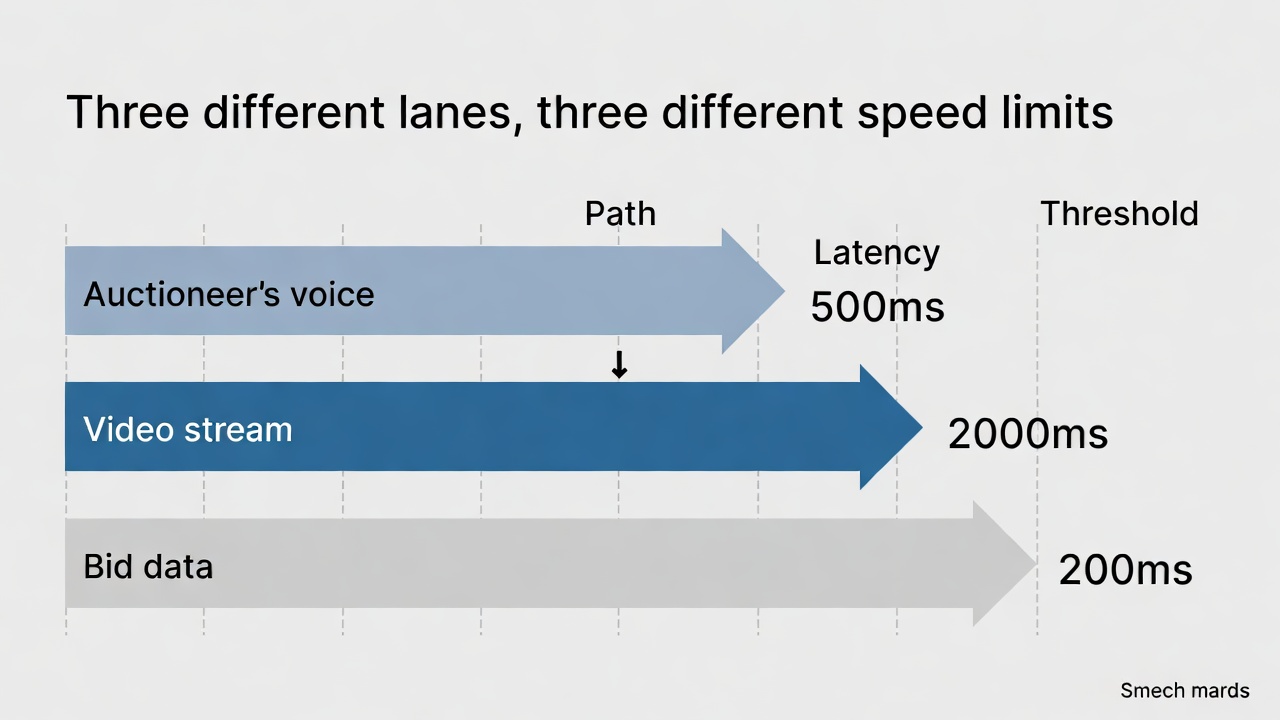
Live audio between the auctioneer and the floor needs to be under 500 milliseconds round-trip. A half-second delay is the boundary between “feels live” and “feels broken.”
Video is more forgiving — up to two seconds of latency is tolerable for the floor camera. The auctioneer is calling the lot based on a slightly delayed picture of it, which is fine because the lot isn’t moving fast.
The bid path — the actual click from an online bidder to a recorded bid in the auction software — needs to be under 200 milliseconds. Otherwise online bidders feel like they’re always one step behind, and you’ll get complaints.
Selling Lane’s live-data simulcast handles the bid path under 200ms in normal network conditions. Audio rides over a separate VoIP channel, which keeps it under the 500ms threshold even when the video stream is shaky. The dashboard the auctioneer is staring at refreshes in under a second so the “Internet Winning” indicator lands on his screen before the call gets ahead of it.
A real walkthrough: a 6-hour estate sale, two states apart
An estate liquidator we know — based in Boston, contracted to clear a barn in central Pennsylvania — ran exactly this setup last fall. The barn had no in-person bidders by design (insurance and access logistics). 100% of the auction was online.
Their setup, end to end:
- The auctioneer worked from her home office in Boston. Hardwired internet, a 2-monitor laptop, a $90 USB headset, and a backup Verizon hotspot.
- On-site in PA, they had two staff: one block clerk on a Lenovo tablet running Selling Lane, one runner with an iPhone 14 on a tripod streaming via the platform’s built-in simulcast.
- The auctioneer’s second monitor showed the runner’s phone feed. Her primary monitor showed the catalog, current bid, internet bidder count, and the “Internet Winning” indicator.
- The auction ran from 10am to 4pm with two 15-minute breaks scheduled in advance. Total: 380 lots cleared, $74,200 hammer.
- Three technical incidents during the day. One: phone overheated and needed a swap (handled in 90 seconds because they had a spare on the tripod beside it). Two: home internet hiccup; auctioneer cut over to hotspot in 8 seconds, never lost the call. Three: a bid that didn’t register because the bidder had a network error on their end — handled by re-opening the lot and accepting the bid live.
Total tech-related delay across six hours: under three minutes. The auctioneer never left her chair. The consignor got paid the following Tuesday. The estate cleared.
Four failure modes (and how to plan for each)
1. The auctioneer’s internet drops
If the only path between the auctioneer and the floor is one cable modem, you have one failure point and a six-hour auction at risk. The fix is the backup hotspot on a different carrier. Set it up before the auction, test the failover, then leave it plugged in. If the cable goes down, the auctioneer’s laptop swaps networks in seconds.
2. The video stream from the floor freezes
You’ll get this. Cameras crash. Phones overheat. Networks burp. The fix is having a second camera on a backup phone or tablet, already streaming, that the auctioneer can switch to with one click. Most simulcast platforms support multi-camera failover; check yours before you need it.
3. The audio path picks up echo or feedback
If the auctioneer’s voice plays back to her through the floor camera’s mic, you get a feedback loop and the call sounds like a bad ringtone. The fix is muting the floor camera’s audio entirely — the auctioneer doesn’t need it; the floor speaker is for in-room bidders only. The block clerk uses a separate VoIP channel for direct conversation with the auctioneer when needed.
4. An online bidder gets stuck on a stale bid
This is the tricky one. If a bidder’s screen says they’re winning but the platform actually has them outbid, they’ll be furious when the gavel falls. The fix isn’t at the bidder end — it’s the platform’s data path. Live-data simulcast pushes bid changes to every connected client in real time so “you’re winning” on the bidder’s screen actually means it. If your platform polls every five seconds instead of pushing, plan to handle disputes the old-fashioned way.
The settlement side — checkout when nobody’s in the same place
Hammer prices are only half the auction. Money has to move and items have to ship.
- Invoices auto-generate at close. Selling Lane’s invoicing sends them to winning bidders within seconds — no manual emailing.
- Payments happen through the platform. Cards, EFT, Venmo, PayPal. The auctioneer doesn’t handle a check; the platform handles the cash flow and reports back.
- Pickup or shipping is the on-site team’s job. The block clerk now becomes the pickup coordinator. Buyers schedule pickup windows or pay for shipping, and the on-site team scans an invoice barcode to release the lot.
- Consignor settlement is automatic on the platform side — revenue minus fees, paid out per the consignment contract.
What this changes about who can be an auctioneer
The biggest implication is the one most auctioneers haven’t fully internalized: the geography of who can run your auction is no longer the geography of the inventory.
If you’re a consignor in Vermont and the best estate auctioneer in the country lives in Arizona, you can hire him. If you’re an auctioneer in Boston and a contract opens up in Idaho, you can take it. The constraint that used to determine who runs your sale — physical proximity — is gone for any auction where the platform supports remote auctioneering well.
That changes pricing. It changes specialization. It changes who’s on your short list when a consignor calls. The auctioneers who figured this out first are the ones whose calendars are full and whose competitors are still driving four hours each way.
If you want to test it, the cheapest way is to volunteer to run a local nonprofit’s charity auction remotely — you’ll learn the gear list and the failure modes on someone else’s low-stakes night. By the third one, you’re ready to charge for it.
Selling Lane’s simulcast streaming, block-clerking interface, and real-time dashboard were built specifically for this setup — on the assumption that the auctioneer might not be in the same building as the lot. One flat monthly fee, no per-event surcharge, no extra cost for running auctions where your auctioneer is two thousand miles away.
Same software, same auction, longer commute home.