Walk into any live auction house in America on a Saturday morning and ask the auctioneer who’s the most important person on the floor besides him.
You’ll get one of two answers, and they’ll come fast.
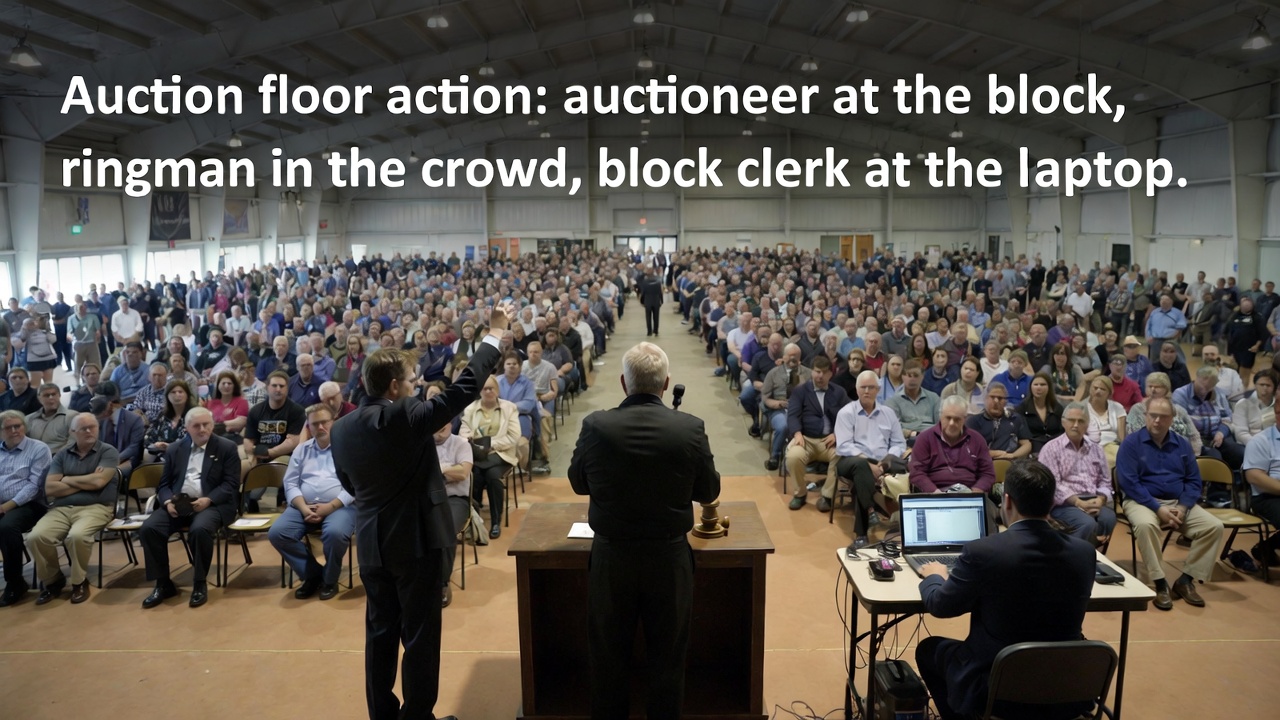
The traditional answer is the ringman — the bid-spotter who works the crowd, calls bidders by name, leans in to ask “you in?” when somebody hesitates, and turns sideline interest into actual hammer prices. He’s the auctioneer’s amplifier. Without him, half the bids in the room never get caught.
The other answer — the one you’ll hear from auctioneers who’ve learned it the hard way — is the block clerk. The person sitting at the laptop next to the auctioneer, recording the bid, the bidder number, and the close. The person who decides what the consignor gets paid, what the buyer owes, and whether your auction has a defensible record of what happened.
Both answers are right in their own way. But only one role, when it goes wrong, can take down the entire sale.
The case for the ringman
Ringmen are the auctioneer’s eyes. A good auctioneer can call the chant beautifully, but he’s standing six feet above the floor with a microphone. He cannot read a buyer’s body language at the back of the room. He cannot see the small nod from the wholesale guy in row four. He cannot talk a hesitant bidder past the next increment.
The ringman can do all of that.
A great ringman moves prices. The same lot, the same auctioneer, the same crowd — switch a B-team ringman for an A-team ringman and the hammer total at the end of the day climbs by 5–15%. Every long-time auctioneer has watched this happen on the same Saturday with the same inventory. The ringman is the difference between a $40,000 day and a $46,000 day.
That’s a real case. It’s why the “ringman is most important” answer is the default.
The case for the block clerk
The block clerk doesn’t move prices. The block clerk doesn’t excite the crowd. The block clerk barely looks up from the laptop screen during a fast call.
What the block clerk does is decide whether any of those prices stick.
Consider what happens at the gavel. The auctioneer says “sold, $5,200, bidder 47.” That sentence is fast. It’s also the only record of the sale that exists for the next ninety seconds. If the block clerk doesn’t catch the bidder number, doesn’t flag the right run number, doesn’t hit SELL on the right lot — the auction has just generated a dispute it cannot resolve from memory. The buyer goes to checkout and finds a different number on the invoice. The consignor gets paid for a sale they didn’t make. Or worse, a sale they made gets credited to somebody else.
The ringman makes one Saturday better. The block clerk makes every Saturday possible.
A real example: the Saturday that cost an auctioneer $11,000
An auto auction in the Midwest, about three years ago. Mid-tier weekly dealer sale, around 50 cars on the block. The auctioneer is good. The ringman is good. The block clerk is a high-school senior, three Saturdays into the job, working from a generic auction-software spreadsheet that doesn’t tell her what reserve any given lot has and doesn’t make it obvious when an internet bidder is on top.
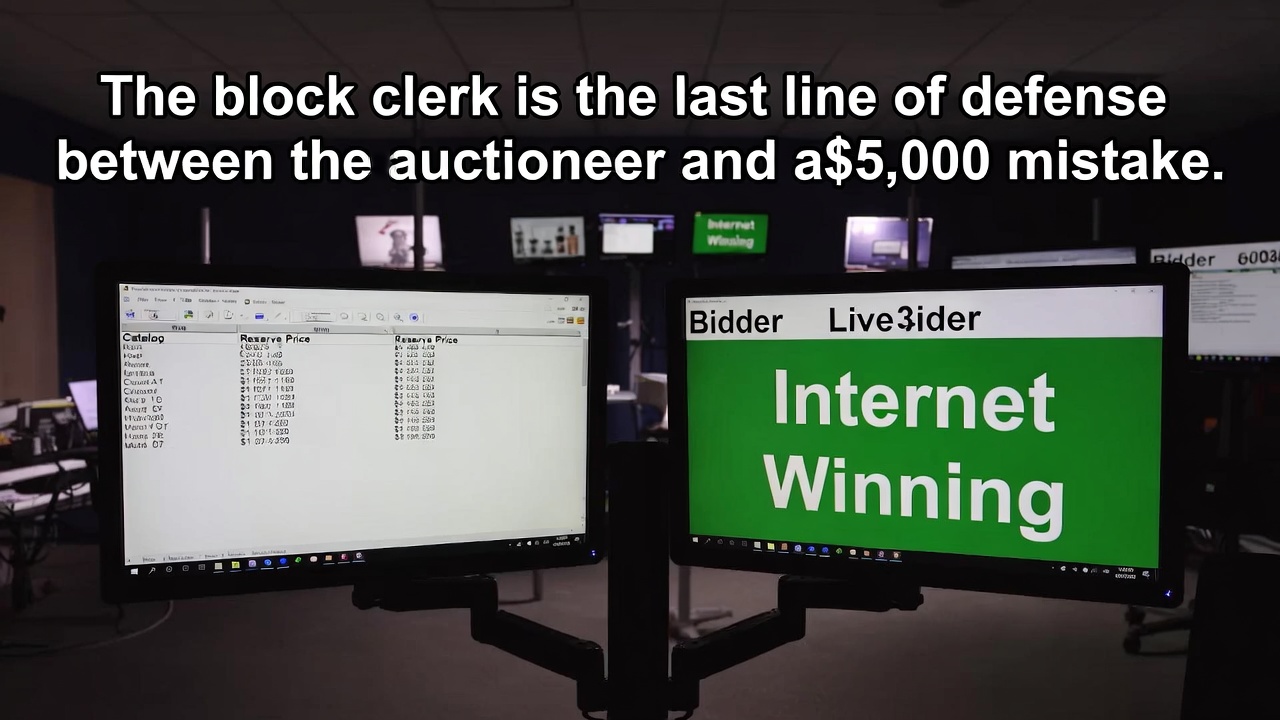
Around lot 31, an online bidder had the high bid at $11,200. The auctioneer didn’t see it on his block screen because the software refresh was lagging by ninety seconds. The ringman thought a floor bidder was about to step in and didn’t signal. The clerk didn’t notice the “Internet Winning” indicator because there wasn’t a clear one. The auctioneer hammered to a floor bidder at $11,000.
By Tuesday, the online bidder had filed a complaint with the auction’s state board, threatened legal action, and posted on three different dealer forums. The auctioneer ate the difference, refunded both buyers, and ate the cost of the dispute. By the end of the month, the actual cost of that one missed bid — the refund, the legal threat, the reputation hit on the dealer forums, the next two weeks where online registrations dipped — was a little over $11,000.
The ringman didn’t cause that. The auctioneer didn’t cause that. The block clerk didn’t cause it either, technically. The system the block clerk was using caused it. And the only role that could have caught it in real time was the block clerk.
“What gets measured gets managed.”
— commonly attributed to Peter Drucker, codified in modern operations leadership
The block clerk is the measurement layer of a live auction. Everything else — the crowd, the chant, the ringman’s eye contact — is energy. Energy without measurement is theater. Measurement is what turns theater into a business.
Why this debate has changed in the last five years
Twenty years ago, the “ringman is most important” answer was correct. Auctions were rooms. Bidders showed up in person. The ringman’s ability to coax one more bid out of a hesitant buyer was, mathematically, the highest-leverage skill on the floor.
That math has flipped.
Today, more than half of the bids at most live auctions come from online bidders. Some auctioneers are running events where 80% of the dollar volume is remote. The ringman’s reach is still excellent — but it ends at the room. The block clerk’s reach is the entire internet.
If the block clerk has good software and a good system, every online bidder is in the room with the ringman. They can be relayed in real time. They can be matched against the floor. They can be pushed into a higher bid via an “Internet Winning” indicator that lights up the moment they take the high.
If the block clerk has bad software, it doesn’t matter how good the ringman is. The online half of your auction is invisible.
The leadership reframe
So who’s most important?
The honest answer for a modern live auction with internet bidders is: the role you under-invest in is the one that’s costing you the most. Most auctioneers over-invest in ringmen (they hire experienced ones, train them, pay them well) and under-invest in block clerks (they grab a family member, hand them a laptop, and hope). That asymmetry made sense when 100% of the bidders were in the room. It doesn’t make sense anymore.
The auctioneer who treats the block clerk as the second-most-important role on the floor — staffs it with a senior person, trains them on the software, gives them a screen layout that surfaces what matters, pays them what the role is actually worth — is the auctioneer whose hammer prices, dispute rates, and bidder retention numbers all pull ahead of his peers within a year.
What the block clerk needs from your software
The block clerk is a force multiplier — or a bottleneck — depending on the tools. The minimum viable block-clerk software:
- Run number, reserve, and starting bid pre-loaded the moment the auctioneer hits a new lot — no typing during a call.
- One-tap bid increments in $100, $200, $300 jumps that match the auctioneer’s pace, plus matching one-tap reverses for take-backs.
- An unmistakable “Internet Winning” indicator the moment a remote bidder beats the floor — not a number to interpret, an indicator to glance at.
- SELL / No Sale / If Sale close buttons that match the three real outcomes off an auction block, with the platform handling the invoice and consignor paperwork in the background.
- One source of truth for the bid, shared with the auctioneer’s dashboard, the room’s TV display, and every online bidder — no two screens that disagree.
Selling Lane’s block-clerking interface is built around exactly that list, because every dollar of difference between “the block clerk is the most important person on the floor” and “the block clerk is a teenager with a spreadsheet” ends up showing in your hammer total at the end of the year. The dashboard, TV display, and simulcast streaming all stay in sync because they read from the same record the block clerk is writing.
So — ringman or block clerk?
Both. Stop choosing.
The ringman is the auctioneer’s amplifier. The block clerk is the auctioneer’s memory and the auction’s guarantee. A great ringman without a great block clerk produces an exciting day with a paperwork trail you can’t defend. A great block clerk without a great ringman produces a quiet day with perfect records that don’t hammer high enough.
You need both. But if you’ve been treating the block clerk as the cheap seat at the front of the room, the data says you’re leaving more money on the table than the ringman is earning you. The compounding business is the one that staffs both roles like they matter. Because they do.
The most important person at your auction isn’t the ringman or the block clerk. It’s the auctioneer who finally figured out they’re both first.