The best auction companies do not just sell inventory. They build a buyer base.
That sentence sounds like a marketing line, but it’s actually a leadership decision. Two auctioneers can run the same Saturday sale, hammer the same total, pay the same staff, and walk away with two completely different businesses — because one of them is compounding and the other is starting over from zero on Monday morning.
The difference isn’t hustle. It isn’t skill on the block. It isn’t even marketing budget. It’s the system underneath the sale.
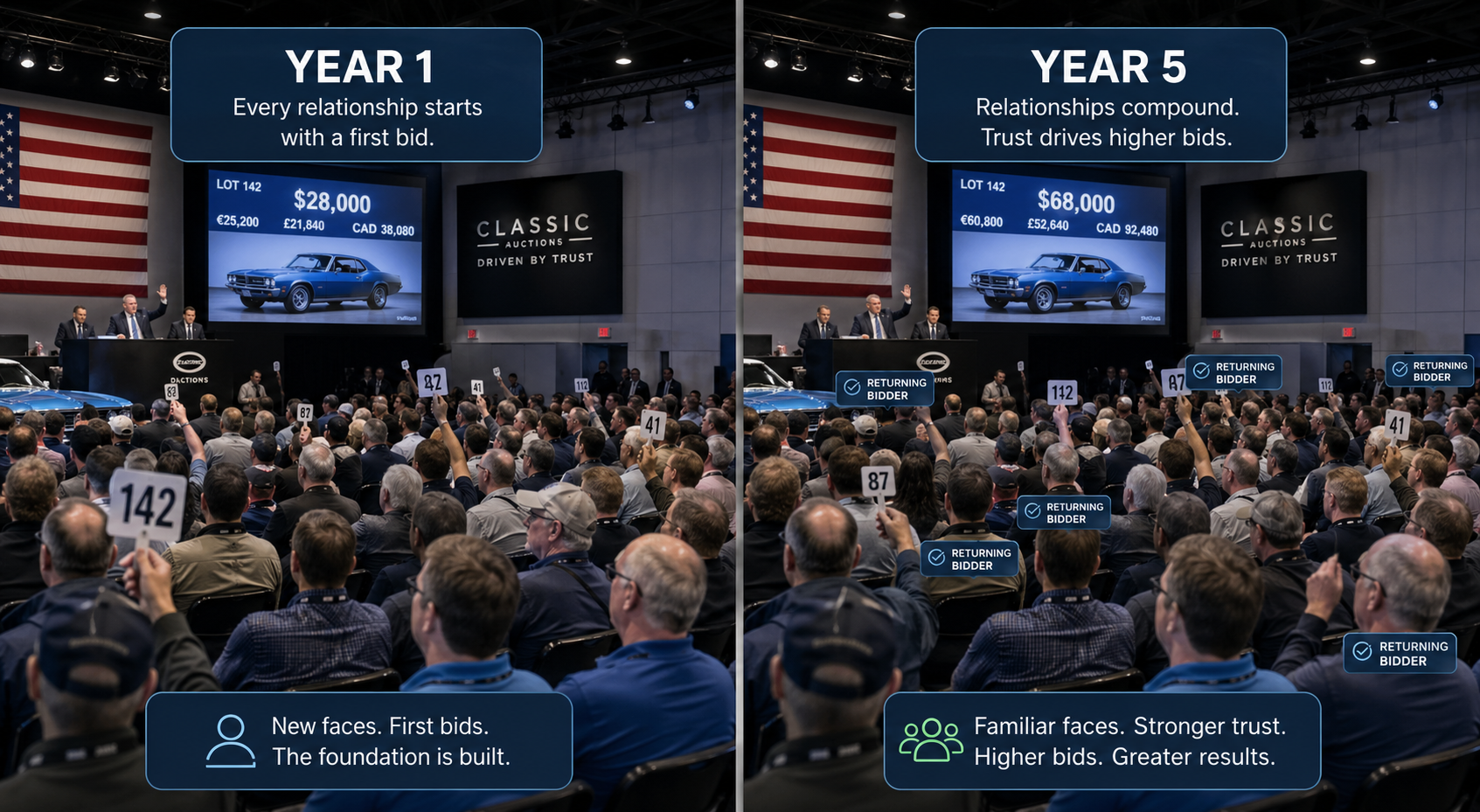
The two kinds of auction businesses
Step back from the daily grind for a minute and look at the auction industry from a long-term-leader’s seat. There are really only two kinds of auction businesses out there:
- Extractive businesses chase inventory. Every month, a new consignor, a new sale, a new round of marketing spend, a new pile of first-time bidders. Revenue happens, but nothing accumulates between auctions. Year five looks suspiciously like year one — only more tired.
- Compounding businesses chase relationships. Every month they pick up new consignors and new bidders, but they also keep the ones from last month. The bidder list grows. Re-bid rates climb. Marketing dollars work harder because last quarter’s bidders are already on the list. Year five looks like year one, scaled.
Both can be profitable in the short run. Only one of them is a business you could hand to your kids.
The leadership question isn’t “did we sell well today?” It’s “did today’s sale make tomorrow’s sale easier?”
What “every sale strengthens the business” actually means
If you take that leadership lens seriously, every auction has to do more than clear inventory. Each sale should be an investment in three durable assets:
- Your bidder list. Names, emails, phone numbers, addresses, and bidding history that you own and can email tomorrow. Not the platform’s list. Yours.
- Your brand recognition. The bidder who bought your lot remembers your company name, sees your logo on the receipt, and types your URL into the browser next time. Not a marketplace’s.
- Your reputation for service. Clean invoices, predictable pickup, consistent communication, the same auctioneer voice from sale to sale. None of that compounds if a different platform’s template is sending the emails.
If your software, your contract, or your fee structure prevents any of those three from accumulating, your “growth” is rented growth. The day you stop paying, it walks out the door with the platform.
Real example: the auctioneer who realized he was running thirty first-time auctions a year
An auctioneer we’ll call Ray runs twice-monthly online auctions of mixed estate, antique, and small farm items. Healthy business — about $1.4M in gross hammer last year, with a small full-time team and a pair of seasonal helpers.
Ray sat down at the end of last year and ran a number he’d never run before. Out of every Saturday’s registered bidders, what percentage had bid with him at least once before?
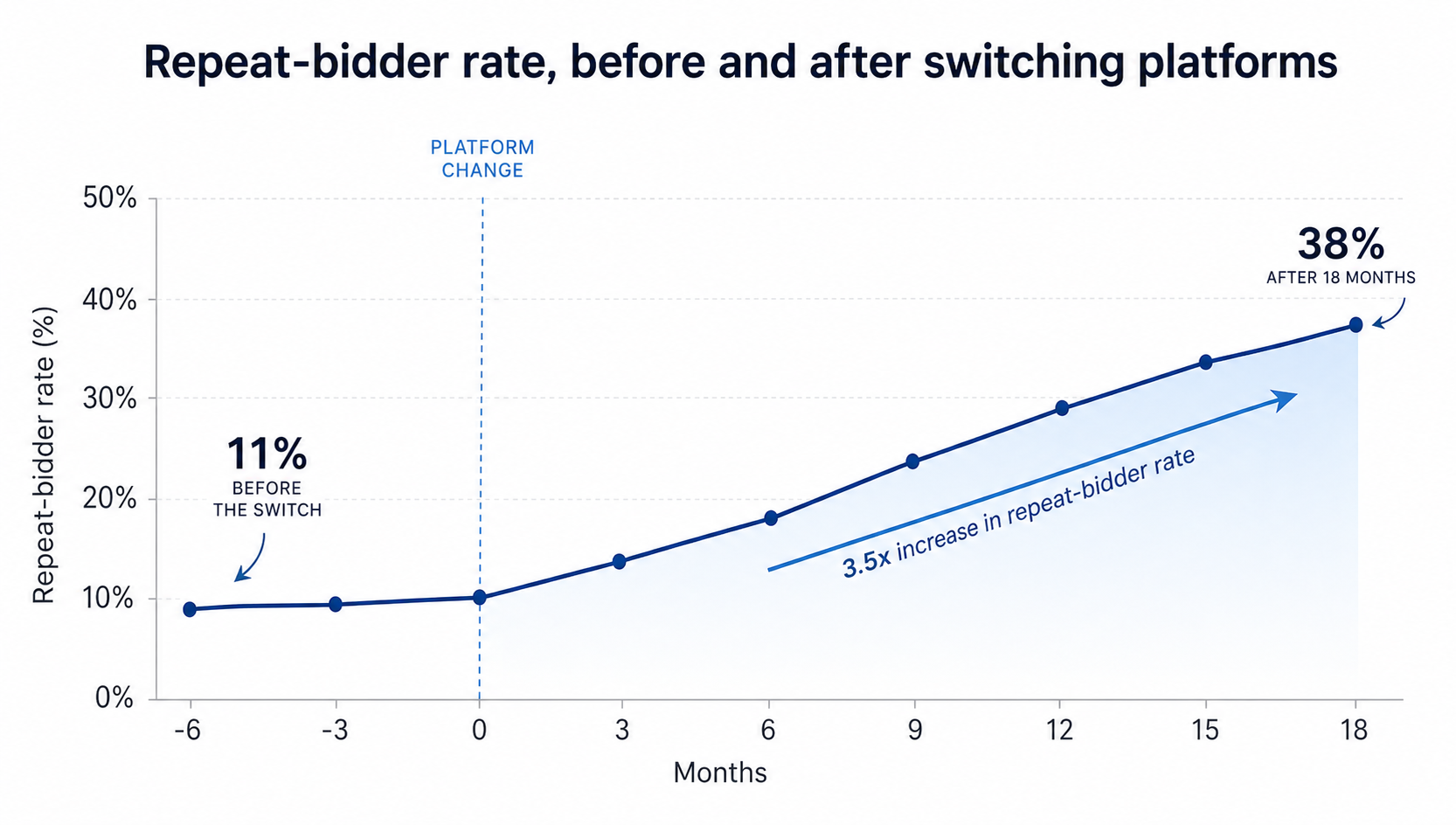
The answer was 11%.
Ray was, in effect, running thirty first-time auctions a year. Every two weeks, he was paying to acquire bidders, only to hand most of them back to the platform when the sale ended. The platform’s recommendation engine, email list, and global search bar all quietly recycled his bidders to other sellers. He’d been running a treadmill — fast, but not actually moving.
The fix wasn’t a marketing campaign. It was a software change. He moved to a system where he owned the bidder list, ran every auction on his own domain, and could send a “new sale this Saturday” email from his own address to bidders he’d already won the trust of.
Eighteen months later, his repeat-bidder rate was 38%. Same team. Same town. Same kind of inventory. The compounding had been there all along — he just wasn’t allowed to keep it.
“Hope is not a strategy.”
— Jensen Huang, founder and CEO of NVIDIA
Huang says this often, in different forms, when talking about how NVIDIA designs for the long arc instead of the next quarter. The lesson translates exactly: hoping bidders will remember your company isn’t a strategy. Building a system that puts you in front of them again — that’s a strategy. The auction business that survives the next decade is the one whose leader stopped relying on hope years ago.
The leadership math: compounding vs. churn
Run two simple scenarios in your head. Both auctioneers run twenty-four sales a year and average two hundred registered bidders per sale.
- Auctioneer A runs on a marketplace and gets 10% repeat bidders. After one year, the bidder pool that knows the company is roughly 4,800 names — but that pool is the platform’s, not theirs.
- Auctioneer B owns the bidder list and gets 30% repeat bidders. After one year, the email list of bidders who’ve transacted with the company is the same 4,800 names — and they belong to the company. Year two, that list is feeding the top of every sale before any new marketing spend.
Same effort, same Saturday, two completely different businesses by year three. The leadership work is choosing the system that makes year three possible.
How Selling Lane is built for leaders who think this way
Selling Lane was designed around the compounding model:
- Every auction runs on your domain. Bidders bookmark you, not the vendor.
- Your bidder list is yours — exportable on demand, in CSV, no per-record fees.
- Zero transaction cuts. The buyer premium and seller premium stay with you, so growth funds your business, not someone else’s software.
- Flat monthly pricing. Whether you run two auctions or two hundred, the bill doesn’t punish you for compounding.
For the cost-side leadership view, see the companion post on protecting the margin. For a side-by-side against the largest hosted marketplace, see Selling Lane vs. HiBid.
Five questions a leader asks before signing a platform
- What percentage of my registered bidders this year have bid with me before? (If you don’t know the number, the platform isn’t helping you compound.)
- If I cancelled my contract tomorrow, do the bidder relationships come with me?
- Who sends the emails my bidders read — me, or the platform?
- When a bidder Googles my company, whose URL ranks first?
- If I keep doing exactly what I’m doing for five more years, am I building an asset I can sell, or a treadmill I can’t step off?
Auction leadership isn’t about hammering one more lot. It’s about building a system where every gavel strengthens the company that swung it.