A white-label site should still feel like your business.
That sentence sounds obvious, and yet most platforms billed as “white-label” break it within five clicks. The logo at the top is yours. Everything else — the URL, the checkout, the email-receipt sender, the buyer’s account dashboard, the password-reset flow — quietly belongs to someone else.
For an auction business, that’s not a cosmetic problem. It’s a brand-equity leak. Every place a bidder sees the vendor’s name instead of yours is a place where the relationship slips out of your hands.
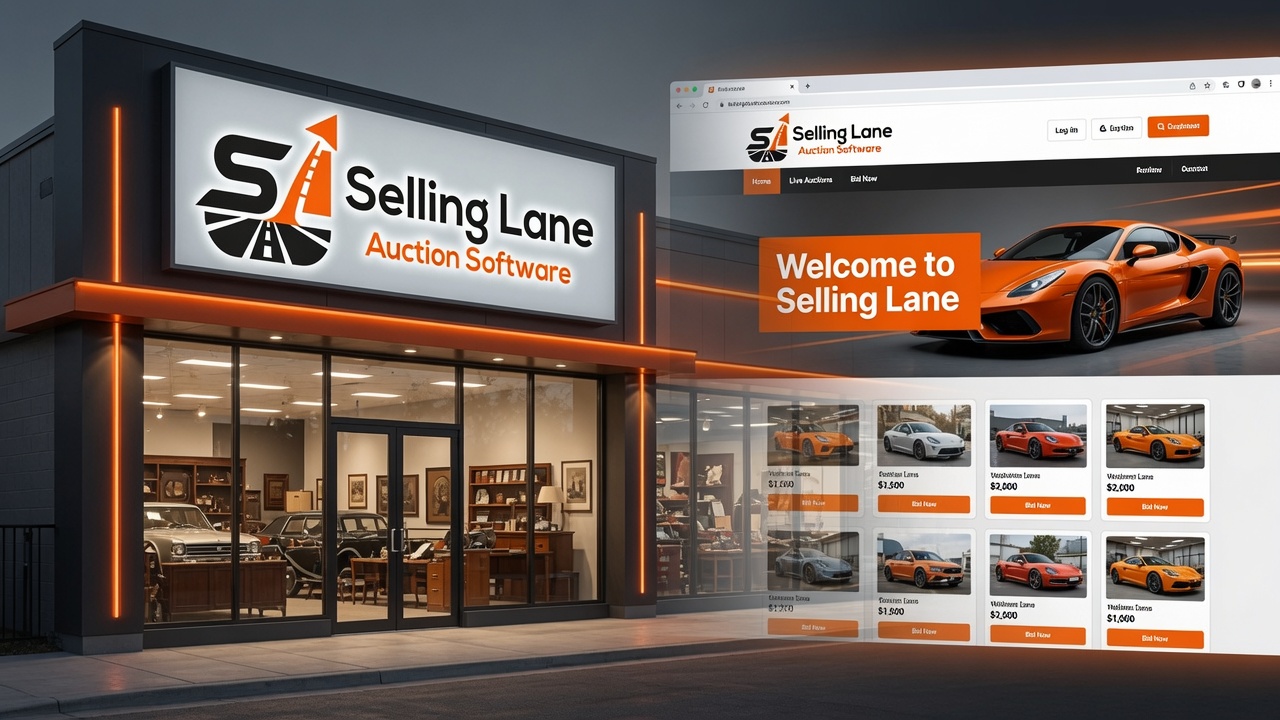
What “white-label” is supposed to mean
The promise of white-label is simple: bidders experience your brand, not the platform’s. Your colors, your logo, your domain, your tone of voice. From the bidder’s seat, the platform underneath is invisible — the way a great kitchen appliance disappears into a great kitchen.
The reality, on most platforms, is closer to a generic restaurant that lets you pick your own placemats. The food still tastes like the chain.
Where most platforms break the white-label promise
Watch for these tells. Any one of them means the platform is leaking the vendor’s brand into your sale:
- The URL. If your auctions live at
youraccount.theirplatform.cominstead ofauctions.yourcompany.com, your bidders are bookmarking the platform. - The receipt email. If the “from” address is the platform’s, every winning bidder learns the platform’s name on the most emotional moment of the auction — right after they won.
- The bidder account. Many platforms create one shared bidder account across all of their seller customers. So when a bidder logs in on your site, they see every other auction running on the platform too — including your competitors’.
- Cross-promotion. The “you might also like” strip on a winning-bid page rarely points to your other sales. It points to whichever auction is paying the most for placement that week.
- Mobile app. If the bidder downloads an app to bid, and the icon on their home screen shows the platform’s logo, you’re training them to remember the wrong brand.
- Marketplace search. If your lots show up in the platform’s global search alongside everyone else’s, you’ve been bundled into a marketplace whether you signed up for that or not.
Each one is small. Stack them and the bidder’s mental map of “where I bought that thing” shifts away from your company and onto the platform. That’s the moment a white-label deal stops being white-label.
Real example: the regional auctioneer who lost a buyer to the vendor’s marketplace
A regional firearms and sporting-goods auctioneer we’ll call North County had been on a self-described “white-label” platform for three years. Their auctions ran at northcounty.platformname.com. The team accepted that as close enough.
Then a long-time bidder called the office to complain. He’d gone looking for North County’s next auction by typing the company name into Google. The first three results were the platform’s domain — his bookmarks pointed there too. He’d clicked the platform’s home page, browsed the global “featured auctions” strip, and ended up bidding (and winning) at a competing auction in another state.
He wasn’t poached on purpose. The platform was simply doing what platforms do: maximizing engagement across their audience. North County’s logo at the top of the auction page didn’t change the fact that the underlying URL, search results, and “you might also like” carousel all favored the platform.
The fix wasn’t a marketing campaign. It was getting their auctions onto a real domain they controlled, with a bidder list that didn’t spill into a global marketplace.
“Greatness comes from character.”
— Jensen Huang, founder and CEO of NVIDIA
Huang’s point, made in the context of building a long-lived company, is that what makes a business endure isn’t the cleverness of its tools — it’s the consistency of its character over time. For an auction company, that character is the brand. The voice. The way your invoices read. The colors. The phone manner. The sense, for a returning bidder, that they’re back somewhere familiar.
You can’t build that character on someone else’s URL.
What true white-label looks like on Selling Lane
Selling Lane treats “white-label” the way the word actually reads:
- Your domain, end-to-end. Auctions run at the URL you choose —
auctions.yourcompany.com, or your root domain, or a custom path. The browser address bar shows your business, not ours. - Your design language. Colors, logo, typography, header layout. Bidders moving from your homepage to your auction site shouldn’t feel a seam.
- Your buyer relationship. Bidders register with you. The list is yours, exportable on demand. There’s no global marketplace bundling your auctions with your competitors’.
- Your emails. Receipts, outbid notices, invoices, pickup reminders — all sent from your domain, in your voice, with your phone number.
- Your fees. A flat monthly fee with zero transaction cuts. The platform doesn’t take a slice of your buyer or seller premium, so growing your brand never grows your software bill.
For the side-by-side mechanics, the how-it-works walkthrough shows how a Selling Lane site stays inside your domain from the first click to the final invoice.
A brand-leak audit you can run today
Open your current auction software in a private browser window and run through this checklist as if you were a first-time bidder:
- What’s the URL of the auction page? Whose domain is it on?
- If you bookmark the page, what title does the bookmark save as — your company’s, or the platform’s?
- Click “register.” Whose terms are you agreeing to? Whose privacy policy?
- Place a bid. What does the confirmation email’s “from” address say? What about the outbid notice?
- Try to reset the password. Who sends that email?
- Look at any sidebar, footer, or “more auctions” strip on the page. Are those your other sales — or the platform’s entire global catalog?
- If a mobile app exists, whose icon shows up on the bidder’s phone?
Every place the answer comes back “theirs” is a place a competitor is one click away from your customer.
The goal isn’t to look custom. It’s to be the brand a bidder remembers tomorrow. Your auctions, your customers, your premiums, your URL.